

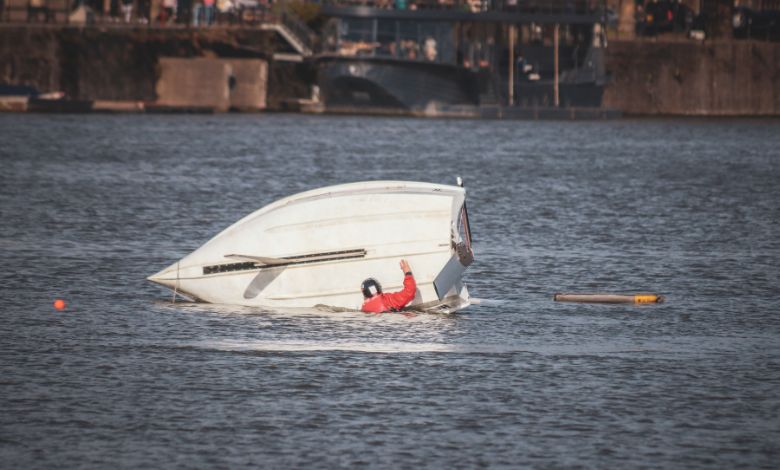

Your boat capsizes and floats away, what should you do? Stay calm, stay with the hull, conserve body heat, and signal for rescue fast.
I still remember correctly. The second fell into my stomach, my life jacket. That was a gray Tuesday morning but a lake in Wisconsin. The water felt colder than it deserved to step into. June.
Mine buddy’s The 16-foot aluminum boat capsized so fast there was no time to catch it with the sunglasses on my head. One second I swung. A bass. I then treaded water and watched the hull walk away as if it was better to have him, and it struck me right then how quickly a moment like that turns into a matter of personal law , who’s liable, who’s covered, who’s responsible for what happens next.
What to do If Your boat sinks and floats.
Sustain calm. Stay together on the boat. Don’t track him.
If your boat capsizes and floats away, Seek your life jacket Remove it immediately, a headcount of everyone on board, And stay finalize the vessel If it still flows. Never swim After a drifting boat. Climb on the hull or hold its side, Group with other survivors to save body heat, and signals for rescue. A sinking boat is easier said than done for rescuers. A lone swimmer, so stabbing almost always beats swimming. Shore.
Now let’s break down how you go about it. Each step.
The first 60 seconds is the most important thing.
Capsing is fast. One moment you’re straight, next you’re in the water, disoriented, maybe a little embarrassed, definitely scared. This first minute is the most dangerous window of the entire ordeal, and what you do( or don’t do) here shapes everything that follows.
Your body will panic at first. Your mind, even prisoners. Adrenaline Flood in Your Shortness of breath. Your instinct shout” swim, swim anywhere.” Resist That desire. Fear and panic burns oxygen and energy. You have to survive and this is the cloud. The judgment you require most right now.
Here’s Your 60 second checklist:
- Breathe and receive. Your bearings. A few conscious breaths pull you back. The edge of panic.
- Do it a headcount. Call the names out loud, one but a time, and wait for each person’s solution before continuing.
- Examine for catch. Look down to establish assured no one is getting tangled in the ropes and that it is safely trapped beneath the hull.
- Get flotation on each. Secure life jackets first, always.
I did it headcount almost on instinct that day, mostly for that reason my dad drilled into me esteem a kid.
“ The name first, questions later,” he always said.
That small habit What is really safety instructors to educate today, also
Should you stay together? the Boat or Swim to Shore?
This is where instinct and good judgment generally disagree, and that’s it the real heart of the question everyone’s inquired when your boat capsizes and floats away, every fiber of You desire to exist swim courage the nearest visible object, the boat, Another vessel, or the shoreline in the distance.
Don’t do unless the boat is actively sinking, burning or moving towards it. Genuine danger Like rapids or rocks, go with it.
Here’s Analogy that did this click For me:
Picture yourself. I got lost in a parking lot when applying. Your car. A giant SUV stands up easier. A single person bent between two sedans.
A reversible boat is in operation. The same way. It is large, sits elevated and reflects. More light than anyone could ever locate their head down.
Search- and- rescue teams scan for different shapes and colors, and a hull, Even upside down, You stand out much more than the competition.
There is also a brutal physical reality here. Swimming any real distance I open water Drainage your energy faster from most people Expectations, especially cold water. It sounds like“ it is a hundred yards” from the surface can emerge from an exhausting, hypothermia- inducing ordeal.
If your boat flows more than approx. 50 To 100 feet Far away and still floating, don’t chase it. The risk of exhausting yourself hunting a moving target almost always outweighs the benefit.
Why Staying With The Boat Baits for swimming Shore
- A reversible plow is much more visible than rescuers.
- A person’s head in the water.
- Swimming burns energy and triggers hypothermia. Cold water.
- The boat itself can function as a flotation device once you’re close to it.
- Living together as a group makes it easier for everyone to discover at the same time.
How to use the Hulk Once You are with him.
“ Materialize along the boat”
This doesn’t mean just kidding about it. Use it with care.
Climb on an overturned hull if you can safely. Equalization. Part of Out of your body the water gradual heat loss Dramatic and makes you far more visible to scanned rescuers. The water from a distance or from the air.
If it is not possible to climb up, hold on. The side or a handhold and two the hull support your weight.
Either way, protect your energy instead of fighting. The water.
Here’s Something I learned the hard way:
Avoid walking in water longer. You absolutely must. Knows water on foot. Productive, prefer you’re doing something useful, But it burns your energy Reserves and speed heat loss, Especially cold water.
The HELP Position( Reduce avoidance of heat Posture)
If you’re I alone the water without something solid to catch, to sink into the HELP Position:
- Draw your knees, courage your chest.
- Pack up your arms about your legs.
- Press your torso as concentrated and compact as viable.
It probably sounds a little ridiculous, but that’s how quickly it really slows down. Your body is losing heat.
Huddle up with Others
If other people are with you, go. The individual HELP Position and huddle together Instead, facing each other, cross your arms if feasible and press tightly.
Consider the human version of penguins standing on the shoulder in a blizzard. It works for the same reason: shared body heat.
Observe for Injuries Without Playing Hero
Once everyone is accounted for and reasonably stable, examine the lesions.
Sustain it uncomplicated. Ask direct questions:
- “Are you hurt somewhere?”
- “ Can you move? your arms and legs okay?”
Find out. Obvious signs such as bleeding, confusion or struggling to stay hydrated despite wearing one. A life jacket.
If someone gets hurt, help them flow and offer the basics. First Help only if you are trained and it is actually safe to do so.
It isn’t. The moment you attempt anything you are not equipped for.
Your job: Keeping people calm, keeping them alive and keeping them. Them together to help It won’t come.
A small thing, it’s often the difference between a scary story. Tell me later a real tragedy.
Signal for Help Without Wasting Energy
Once you are stable and grouped together, switch. Your focus is seen.
- Deploy a whistle in short, sharp bursts If your life jacket is one, Do not blow continuously.
- They wave a bright object, a life jacket, a pillow, or piece of clothing, above the water when a boat or a plane is approaching.
- Retain your voice. Withdraw constant yelling And preserve your energy For when a rescuer Terminates enough to actually hear you.
- Pace yourself to wait . It may be longer than you favor, instead of ending immediately.
As I will report. My Past Self Looking Back. That morning But the Wisconsin lake, Bravery is not what passed us by. What happened to us is what we have all heard. These steps Before, if only in passing a boating safety course. When the moment actually arrived muscle memory He took it where he wanted.
If you take one thing from this article, Let it be: live a capsize It is not about strength or bravery. It’s about knowing the sequence, staying calm, head count, life jackets, preserving the boat together, saving the heat, for the signal help.
Practice this sequence in your head before you enter the water. Communicate about it with someone you are struggling with. That five- minute conversation before you go to the dock can really protect you. A life someday, Maybe even your own.
A Few Extra Notes Before you go
A few things It’s worth remembering that the steps don’t fit neatly into the list, but are still significant:
- Cold water everything changes. Even water that feels” cool but tolerable” can shift. Hypothermia is faster for most people. Don’t underestimate it just because of the expectations.
- It’s The summer To wear your life jacket Before you need it. The best PFD in the world If nothing works for you it’s storage under a seat when your boat flips.
- File a float plan. Tell someone on earth your route and expected return time. This little habit shortens dramatically. Rescue response time If something goes incorrect.
Often Asked Questions
What should you do? first when a vessel overturns?
Keep calm, take a headcount of everyone on board, And few life jackets But save every person before you do anything else.
Should you swim at the beach if your boat capsizes and floats away?
Generally speaking, no. Swimming drains energy fast and triggers hypothermia. Stay together with the boat unless it’s sinking or drifting towards its immediate danger.
How do you stay warm while waiting for rescue?
Get more. Your body out of the water Avoid running water as much as possible. HELP Location if you’re alone, or huddle up to share with others body heat.
How far is it to swim? A drifting boat?
If the boat has increased from approx 50 To 100 feet And still floating, don’t chase it. The energy cost outweighs the advantage.
Final Thoughts:
Strengthens. The core takeaway( stay calm, sustain together the boat) I a tight summary Closes the loop.
But the personal- anecdote thread from the intro( D Wisconsin lake history) Ends direct, actionable note Tied back the primary keyword Does not touch or remove.
Any existing content, all original sections, Examples of keywords, and info are still intact
Additional Resources:
- U.S. Coast Guard Boating Safety Division: official guidance on life jackets, float plans, and safe boating practices.
- BoatUS Foundation: free boating safety courses and cold-water survival resources.